From Monastic Orchards to Urban Walls: The Art of Espaliered Fruit Trees
Opening observation: in narrow courtyards and densely built streets, gardeners through the centuries found ways to coax abundance from almost no horizontal soil at all. Espalier — the practice of training woody plants to grow flat against a surface or along a frame — is one of the most elegant of those solutions, blending design, economy of space, and attentive pruning.
Roots in history: why walls and trees have long worked together
Espalier is not a modern invention. It appears in Roman texts and became a staple of medieval monastery gardens, where monks prized both order and utility. Walled gardens offered protection from wind, frost and pests; a tree grown close to masonry benefits from reflected heat and a slightly warmer microclimate. In the 17th and 18th centuries, formal gardens made espaliered fruit a display of horticultural skill as well as a food source.
Those historical reasons still matter. Even in contemporary urban plots, a wall, fence or pergola can extend the season, shelter tender varieties, and allow fruit production where conventional planting would be impossible.
Forms and techniques: simple patterns to try
Traditional espalier forms are essentially patterns for how the branches are arranged. The most approachable for beginners are:
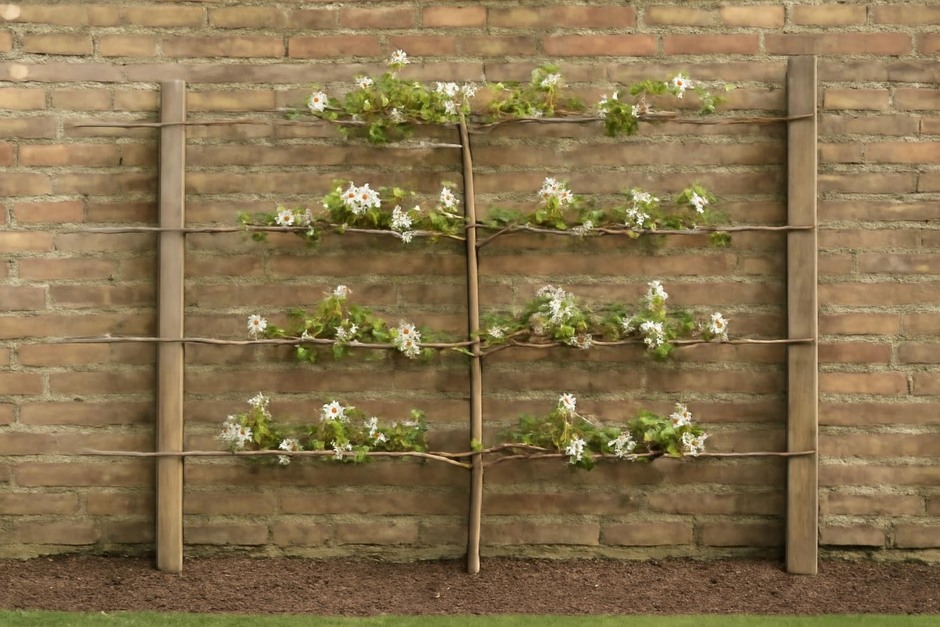
- Horizontal cordon — a single stem with a sequence of horizontal fruiting spurs. Compact and neat, suitable for small walls.
- Belgian fence — a series of trees trained into opposing fans to create a lattice-like screen. Ideal for a boundary line or to divide a garden.
- Palmette — a fan-shaped arrangement often seen in formal gardens. It takes more training but is visually striking.
Technique matters more than pattern at first: regular, patient pruning to establish a main framework, and tying young shoots to supports while they are flexible, are the essentials. Historically, gardeners used twine and wooden pegs; today gentle garden ties and stainless wires provide long-term support without harming the bark.
Choosing the right tree and site for modern practice
Not every fruit tree is equally suited to espalier. Apples and pears are the classic choices because they respond well to pruning and reliably produce spurs along trained branches. Quince and some stone fruits can be used too, but consider winter hardiness and blossom timing for your climate.
Rootstock selection transforms how a tree grows. With dwarfing rootstocks you get manageable height and an earlier crop — useful in small gardens. Place your espalier where it gets full sun for fruit ripening; a south- or west-facing wall in temperate regions is ideal. Ensure good soil drainage and leave enough room for air to circulate to reduce fungal disease risk. If planting against masonry, leave a small gap or use a framework fixed to the wall so the trunk is not pressed directly against stone or brick.
Seasonal, step-by-step starter plan for the first year
- Autumn or early spring planting: Plant a 1–2 year-old whip (a young tree with a single stem) in a trench or hole with enriched but well-drained soil. Water in deeply.
- Install the support: Fit horizontal wires every 30–45 cm up the wall or erect a freestanding frame. Wires should be taut and anchored into sturdy posts or fixings.
- Form the initial framework: In the first dormant season, prune the whip to the desired first tier height (commonly 60–90 cm) to encourage two strong side leaders. Tie these leaders horizontally to the lowest wire.
- Summer attention: Allow new shoots to extend, and tie in flexible growth as it appears. Remove any vigorous vertical shoots that compete with the framework.
- Second winter pruning: Shorten the side leaders to 4–6 buds to promote fruiting spurs rather than long, non-fruiting wood. Repeat framework building on higher wires in following seasons until the intended height is reached.
Maintenance is incremental: an annual light pruning in winter to renew fruiting wood, summer pinching to control vigor, and monitoring for pests and disease. Historically, espalier demanded close attention; today’s gardeners can adopt the same gentle rhythms at a scale that fits city life.
Conclusion: espalier connects us to a long horticultural tradition while offering a practical answer to contemporary limits of space. Whether you adopt a simple horizontal cordon on a small terrace or a modest palmette against a cottage wall, the practice rewards patience more than power tools: a few careful cuts, regular tying, and the subtle satisfaction of turning a flat plane into both a living screen and a source of fruit.